Please read our SITE TERMS in our about page that run parallel with and part of this post. Thankyou.
The Maori and Opportunity parties should not be concerned at all. This was their idea. If there is to be a hung parliment and a rerun is required, we think the people should decide based upon the rules as they are today.
The preliminary results of the November 7, 2026 General Election have left New Zealand’s political landscape suspended in a state of precarious arithmetic. With roughly 399,000 special votes still waiting (they are probably already done) to be counted on November 27, the centre-right bloc clings to a razor-thin 67-to-64 preliminary edge inside a swollen 131-seat Parliament. Yet behind the headline numbers lies a far deeper constitutional and strategic reality: New Zealand’s Mixed-Member Proportional (MMP) system has just been stretched to its breaking point, and the rules that produced this standoff offer National a legal, transparent, and decisive way to break any deadlock—and end backroom post-election horse-trading for good.
For decades, New Zealand voters have been asked to accept an uncomfortable ritual every three years. Parties campaign separately, hedge on their most contentious policies to avoid offending swing voters, and ask the public for a blank cheque. Only after the ballot boxes are sealed do the real negotiations begin behind closed doors in Wellington. Policies are quietly traded away, cabinet seats are bartered, and compromises are struck that no voter ever explicitly endorsed at the ballot box. When National agreed after the 2023 election to support ACT’s Treaty Principles Bill to first reading only for Prime Minister Christopher Luxon to announce it would be voted down at second reading, voters across the political spectrum saw the flaw in full view. Had those exact terms been placed on the table before polling day, voters would have walked into the booth with their eyes open rather than discovering the compromise after the fact.
Now, the 2026 election has exposed an even sharper flaw in the system—and the precedent for fixing it was set not by the right, but by Te Pāti Māori and the Opportunity Party.
How Te Pāti Māori Triggered the Overhang Era
Throughout the 2026 campaign, Te Pāti Māori made no secret of its strategy. By standing candidates across the seven Māori electorates while urging supporters to give their party vote to Labour or the Greens—and by submitting a minimal one-person party list containing only General Secretary Lance Norman to stay on the party-vote ballot—Te Pāti Māori deliberately engineered an MMP overhang. When it won five electorate seats on just 0.57% of the nationwide party vote, four of those seats were added directly on top of the 120-seat Parliament as overhang seats, expanding the House without reducing Labour or the Greens’ proportional share of the base pool.
At the exact same time, National suffered the painful flip side of MMP’s overhang mechanics. By winning 42 electorate seats while capturing 29.21% of the party vote (which entitled it to 35 seats), National created a seven-seat overhang of its own. While those 42 electorate MPs entered Parliament, National’s entire party list was wiped out overnight. Senior ministers and core parliamentary strategists—Nicola Willis, Chris Bishop, Paul Goldsmith, and Speaker Gerry Brownlee—found themselves locked out of Parliament despite the centre-right bloc winning 49.91% of the combined party vote compared to the left bloc’s 43.23%.
The Opportunity Party’s 40-Second Precedent
Meanwhile, Opportunity Party leader Qiulae Wong surged past the 5% threshold with 5.96% of the preliminary party vote, securing seven list seats and positioning herself as the potential kingmaker should special votes erase the right bloc’s narrow margin. In media profiles—including a widely noted Woman’s Weekly interview—Wong explained that she cemented her allegiance to the Opportunity Party in just 40 seconds between reading an advertisement and submitting her application. Her entire political brand was built on discarding old partisan tribalism in favour of rapid, pragmatic realignment around practical outcomes.
Yet as post-election negotiations loom, Wong has already begun laying down personal and policy vetoes from a seven-seat perch—seeking to dictate cabinet composition and policy concessions to parties that collectively represent nearly half the electorate. That posture exposes a glaring double standard. If rapid, pragmatic realignment across party lines is a virtue when Qiulae Wong does it in 40 seconds to enter Parliament, and Maori can aggresivly reinforce they wish to sit with another parties ( two of them and without policy discussion) then the exact same principle applies if National’s four sidelined heavyweights—Willis, Bishop, Goldsmith, and Brownlee—align pragmatically with ACT and New Zealand First on their party lists before an election rerun.
A Clean-Slate Pact Without Changing a Single Law
Nothing in New Zealand’s Electoral Act 1993 stops the centre-right parties from putting an end to post-election guesswork right now. While Section 59 bars a candidate from contesting more than one electorate or appearing on more than one party list, the Act treats electorate nominations and party list submissions as two completely separate legal processes. There is no statutory requirement forcing parties to merge into an identity-erasing umbrella party—which would forfeit the overhang bonus and flatten each party’s distinct ideological voice—to coordinate their campaign transparently before election day.
If special votes on November 27 produce a hung Parliament and force a snap rerun, National, ACT, and New Zealand First could immediately present voters with a transparent, pre-agreed charter:
Full upfront policy transparency: Every shared economic, regulatory, and constitutional commitment—along with any agreed cabinet framework—is published before a single vote is cast, eliminating backroom surprises.
Preserved party identities on the party vote: ACT and New Zealand First retain their distinct party brands, principles, and policy points of difference on the party-vote side of the ballot, giving right-leaning voters genuine ideological choice while accommodating National’s sidelined list ministers on agreed lists.
A clean electorate-and-list division: National contests the electorates (submitting a minimal dummy list to remain on the party-vote ballot), while ACT and New Zealand First campaign for the party vote without splitting right-bloc electorate races
Te Pāti Māori proved in November 2026 that the overhang rules are fair game, and Qiulae Wong proved that rigid party tribalism is obsolete. If Christopher Luxon stands at the podium and makes that exact case—framing a coordinated pre-election slate not as a backroom stitch-up, but as honest, upfront democracy where voters see the entire deal before polling day—Opportunity’s kingmaker leverage evaporates overnight.
The Numbers Tell the Story
If a hung Parliament forces a snap rerun—or if the right bloc applies this exact model in a future contest—the Electoral Commission’s Sainte-Laguë formula shows just how decisive the outcome becomes using the exact preliminary vote totals cast on November 7, 2026 (assuming National’s 706,680 party votes transfer cleanly to ACT and New Zealand First while all electorate results and other party votes remain unchanged):
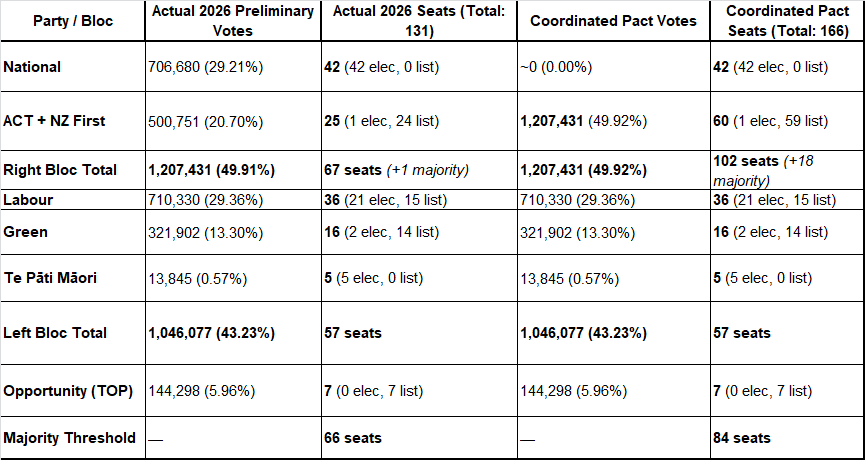
Under the existing law, without changing a single clause of the Electoral Act, National keeps all 42 electorate MPs as overhang seats, while ACT and New Zealand First capture 60 seats out of the 120-seat base pool—opening up 59 list spots (an increase of 35 seats) that easily bring back Nicola Willis, Chris Bishop, Paul Goldsmith, and Gerry Brownlee alongside ACT and NZ First’s own candidates. Instead of clinging to a fragile 67-seat margin held hostage by a 6% minor party, the centre-right commands 102 seats out of 166—an unbreakable 18-seat majority built entirely on the rules Te Pāti Māori used and the pragmatic logic Qiulae Wong championed. Whilst this does bear the financial cost of a rerun, it is a far better use of public funds than three years of fiscal uncertainty. One only has too look at the advantages the Maori and Opportuity parties opened up to give us two open eyes when voting. The second matter in hand is it may, just may, show us how Hipkins is going to handle Maori, Green and Opportunity party taxes.
PS
Chris, heres the deal in Hutt South. If you can convince N Z First not to stand in that seat —wink wink nod nod— and Bishop stand for Act maybe just maybe those 1032 NZ first electorate votes may go to Bishop in that seat. Consequently, the right block you get another electorate seat.
We would urge you not to sweat over the above proposal too much. It was designed by the bureaucrats, and, was endorsed by Geoffrey Palmer at the inauguration of MMP. Further, Labour have been doing this for years with Nanaia Mahuta and Willie Jackson both very active Maori members and were participants in He Puapua that was hiden that from their then coalition partner N Z First.
With reference to the former of those two, she married her first cousin thereby having dual lineage back to an Irish surveyor. Ngāti Maniapoto complained about the survey costs in their Tribunal claims and the Crown formally acknowledged this breach in their Treaty settlement and paid that tribe money. You work it out.